




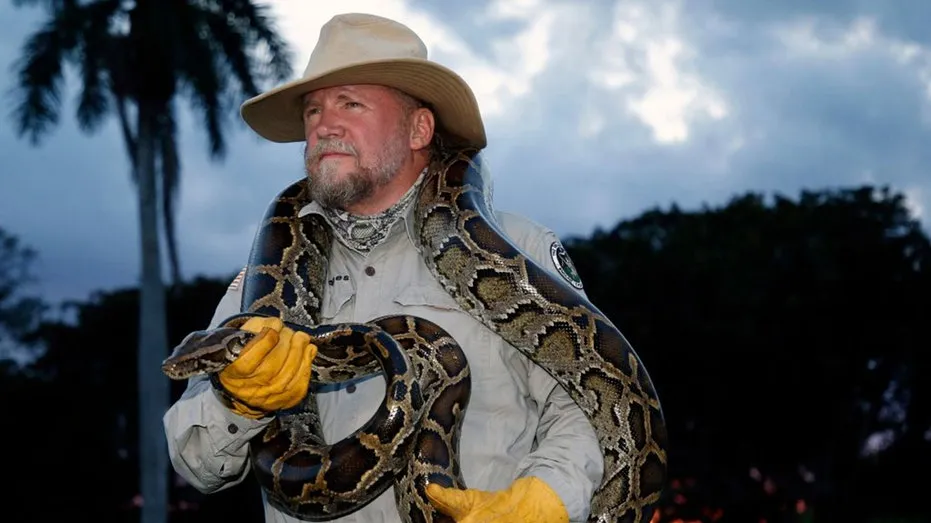
Tom Rahill has emerged as the undisputed champion of the 2026 Florida Python Challenge, a feat he accomplished by removing an astonishing 96 Burmese pythons from the Everglades over a mere 10-day period. This impressive haul not only secured him the ultimate grand prize of $10,000 but also significantly outpaced all other competitors in the annual conservation effort.
A Mission Beyond the Prize
While the substantial cash prize was certainly a welcome outcome, Rahill revealed that his primary motivation extended far beyond personal gain. He founded SwampApes in 2017, an organization dedicated to taking military veterans, particularly those grappling with PTSD, on python hunts in the Florida wetlands. His initial goal for the competition was to help one of these veterans achieve a significant capture.
“I was on a mission to get one of our veterans a big snake,” Rahill shared during a Florida Fish and Wildlife Conservation Commission (FWC) meeting. “I did it. And we wrestled this thing. That was the mission. To get him a big snake — it was a 17-foot female. The veteran was just over the moon.”
With that personal mission accomplished, Rahill then shifted his focus to maximizing his snake count, venturing deeper into the Everglades. It was during this phase that he encountered the majority of the pythons that would ultimately secure his victory.
The Scale of the Challenge
The 2026 Florida Python Challenge attracted a diverse group of 907 participants hailing from 30 states across the U.S., as well as from Canada and Vietnam. These dedicated individuals collectively removed 280 Burmese pythons from eight designated hunting zones spread across South Florida. The competition, which ran from July 10 to July 19, featured various award categories, including professional, novice, and military divisions, in addition to the overall grand prize.
Rahill’s remarkable total of 96 pythons dwarfed the efforts of other top competitors. Christina Kraus secured the professional division win with 36 snakes. Last year’s grand prize winner, Taylor Stanberry, finished in second place overall this year with 34 pythons, earning $1,500. Stanberry had made history in 2025 by becoming the first woman to win the competition, capturing 60 snakes, a mix of 33 females and 27 males.
The longest python prize in the professional division went to Rahm Levinson for his capture of a formidable 16-foot, 5-inch snake.
Conservation at its Core
Beyond the thrill of competition and the allure of prizes, the Florida Python Challenge serves a critical conservation purpose. Burmese pythons, native to Southeast Asia, have become a significant invasive threat in the Florida Everglades, wreaking havoc on native wildlife populations. Their presence has been linked to sharp declines in mammals such as raccoons, opossums, bobcats, foxes, marsh rabbits, and cottontail rabbits.
These elusive predators are notoriously difficult to track due to their exceptional camouflage and secretive nature. Estimates suggest that tens of thousands of these invasive snakes inhabit the Everglades region.
To enhance the effectiveness of the challenge, it has been strategically moved to the summer months in recent years. This timing aligns with the python hatching season, allowing hunters to target and remove young snakes before they can disperse and further impact native ecosystems or prey on local fauna.
Sarah Funck of the FWC emphasized the ongoing nature of the struggle against these invasive reptiles. Speaking to the Naples Daily News, she noted that while there isn’t a single magic bullet to solve Florida’s python problem, every individual snake removed represents a tangible victory for the state’s native wildlife. “The elimination of even one python,” Funck stated, “is a win for Florida’s native wildlife.”
By that measure, Tom Rahill’s 10-day effort delivered 96 significant wins for Florida’s natural heritage, underscoring the vital role that dedicated individuals play in managing invasive species and protecting biodiversity.


