


Trump Seeks Supreme Court Rehearing on Birthright Citizenship
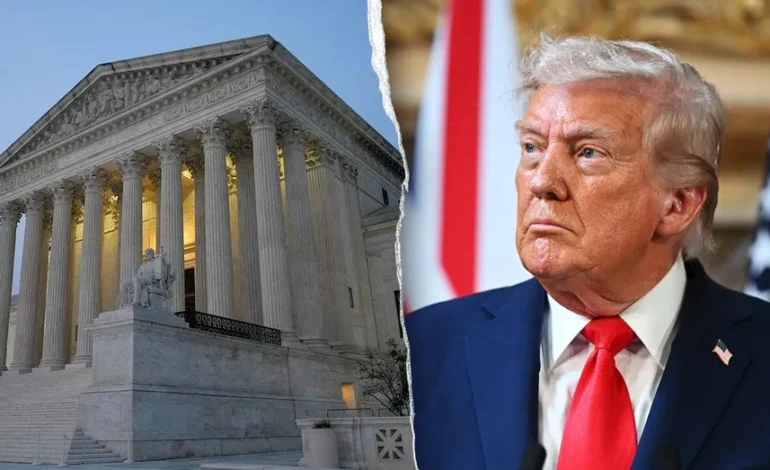

President Donald Trump announced Wednesday that he intends to ask the U.S. Supreme Court to rehear a case concerning birthright citizenship, a legal principle that grants citizenship to nearly all individuals born on American soil. Trump expressed strong disapproval of the court’s recent decision, which affirmed birthright citizenship even for the children of undocumented immigrants and those present in the U.S. on temporary visas. He characterized the ruling as “absolutely insane” and suggested it was already being exploited.
Trump Cites Exploitation Concerns
In a statement posted on his Truth Social platform, the former president claimed to be observing signs and billboards appearing along the U.S. southern border and in Mexico, advertising “birthright citizenship” with prices starting around $4,000 for “deliveries.” He further alleged that similar advertisements were being displayed nationwide. Trump asserted that this practice would lead to billions of dollars being “illegally made by this SCAM,” with citizenship being granted to anyone willing to pay.
This claim echoes concerns previously raised in Texas, where Governor Greg Abbott ordered an investigation after a hospital reportedly advertised “birth packages” to individuals in Mexico, with the state asserting that “citizenship is not for sale.”
Call for Immediate Rehearing
Trump declared his intention to “ask for a Rehearing by the United States Supreme Court, IMMEDIATELY.” He warned that the decision, if not overturned, would “destroy America.” Under court rules, the losing party has a window of 25 days following the ruling to file a petition for a rehearing. However, such a petition requires the agreement of a majority of the justices to be considered.
Supreme Court’s 6-3 Decision Explained
The Supreme Court’s 6-3 ruling, issued on the final day of its session, was authored by Chief Justice John Roberts. The majority opinion affirmed that, under the 14th Amendment, all individuals born within the United States, regardless of their parents’ immigration status or whether they were present lawfully or temporarily, are considered citizens at birth. This decision represented a significant setback for those seeking to challenge or limit the long-standing interpretation of birthright citizenship.
Conservative Reactions and Potential Legislative Avenues
Following the ruling, conservative circles have explored potential pathways to address birthright citizenship. Some have suggested that a constitutional amendment might be the only way to alter the principle. Others have pointed to concurring opinions from justices, such as Justice Brett Kavanaugh, who, while siding with the majority, offered a different perspective. Kavanaugh’s opinion suggested that while the Constitution itself might not explicitly enshrine birthright citizenship in the manner Trump attempted to limit it via executive order, Congress could potentially legislate on the matter.
House Speaker Mike Johnson has indicated that Republican lawmakers are considering legislative action. However, concrete progress or public developments regarding such a legislative push have not yet materialized since the court’s decision was announced.
The Foundation of Birthright Citizenship
The principle of birthright citizenship, often referred to as *jus soli* (right of soil), is deeply rooted in English common law and has been a cornerstone of American nationality law for centuries. The 14th Amendment to the U.S. Constitution, ratified after the Civil War, states: “All persons born or naturalized in the United States, and subject to the jurisdiction thereof, are citizens of the United States and of the State wherein they reside.” For decades, the Supreme Court has interpreted this clause to include children born to parents who are not U.S. citizens, including those residing in the country unlawfully.
Challenges to this interpretation have periodically arisen, particularly during periods of heightened immigration debates. Proponents of birthright citizenship argue that it promotes social cohesion, prevents the creation of a stateless underclass, and aligns with fundamental American values of inclusion. Opponents often raise concerns about national security, the rule of law, and the perceived incentive for illegal immigration, suggesting that birthright citizenship should be contingent upon parental legal status.
The Path Forward
President Trump’s call for a rehearing underscores the ongoing political and legal debate surrounding birthright citizenship. While a rehearing is a long shot, requiring the agreement of at least five justices, it highlights the administration’s determination to challenge the current interpretation. The alternative, as suggested by some Republicans, involves a complex legislative effort, which faces significant political hurdles in a divided Congress. The Supreme Court’s recent ruling has solidified the status quo for now, but the conversation about who is an American citizen by birth is far from over.