




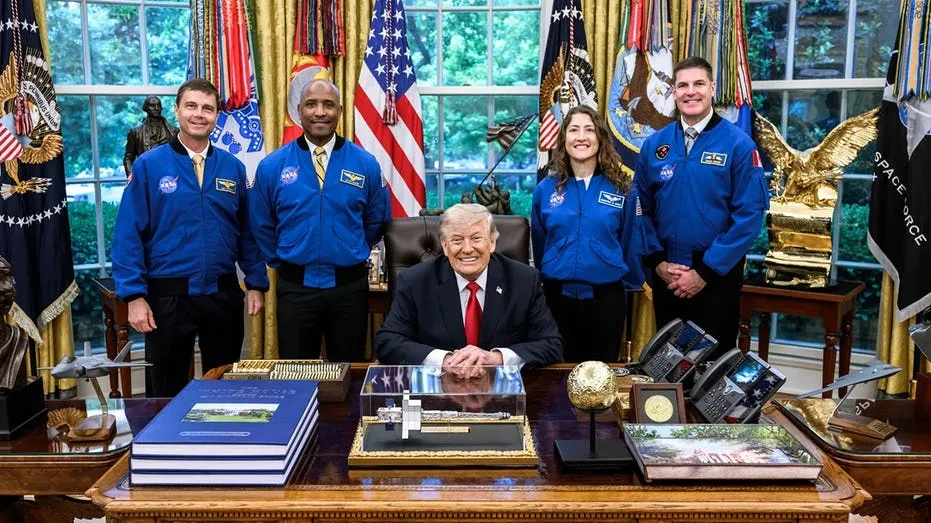
President Donald Trump is scheduled to present the Congressional Space Medal of Honor to the four astronauts of the Artemis II mission, recognizing their groundbreaking journey around the moon earlier this year. This mission marked the farthest humans have ever traveled from Earth, setting a new distance record in spaceflight history.
Artemis II Crew to Receive Prestigious Honor
The ceremony, set for August 28th at NASA’s Johnson Space Center in Houston, will see President Trump bestow the esteemed medal upon NASA astronauts Reid Wiseman, Victor Glover, and Christina Koch, alongside Canadian Space Agency astronaut Jeremy Hansen. Their historic voyage aboard the Artemis II mission, the inaugural crewed flight of NASA’s Orion spacecraft, represented the first time humans have journeyed around the moon in over fifty years.
A New Record in Human Spaceflight
During their nearly 10-day mission, which commenced on April 1st with the powerful launch of NASA’s Space Launch System rocket from Kennedy Space Center, the Artemis II crew reached a remarkable apogee of 252,756 miles from Earth. This distance significantly surpassed the previous human spaceflight record established by the Apollo 13 mission in 1970. In total, the astronauts traversed an astonishing 695,081 miles during their lunar circumnavigation.
The mission involved rigorous testing of the Orion spacecraft’s systems. A key moment occurred on April 6th when the crew passed within 4,067 miles of the lunar surface, conducting a crucial flyby. Throughout their journey, the astronauts captured over 7,000 images, documenting breathtaking views of earthrise and earthset, detailed lunar landscapes including craters and ancient lava flows, and even a solar eclipse as observed from the Orion capsule. They also reported observations of meteoroid impacts on the moon’s dark side.
The Orion spacecraft safely returned to Earth on April 10th, re-entering the atmosphere at approximately 25,000 miles per hour before splashing down in the Pacific Ocean off the coast of California.
The Significance of the Congressional Space Medal of Honor
The Congressional Space Medal of Honor, with its origins tracing back to the Apollo era, was established by Congress in 1969. It is intended to recognize astronauts whose intelligence, dedication, bravery, and self-sacrifice are vital to the success of America’s space program in the challenging environment of space. The law permits the President to award this medal on behalf of Congress to individuals who have demonstrated exceptionally meritorious service and made significant contributions to the nation and humanity.
NASA notes that the medal is awarded to a very limited number of astronauts. To date, there have been 30 recipients, including legendary figures such as Neil Armstrong, John Glenn, Alan Shepard, and Jim Lovell, the commander of Apollo 13. Neil Armstrong was among the first group of six astronauts to receive the medal from President Jimmy Carter in 1978.
With the upcoming presentation to the Artemis II crew, the total number of recipients will rise to 34. This honor underscores the critical role the Artemis II mission played in advancing NASA’s broader goals for lunar exploration and beyond.
Artemis Program: Paving the Way for Future Exploration
The Artemis II mission served as a vital stepping stone toward the ultimate objective of returning humans to the lunar surface. During the mission, the crew rigorously tested Orion’s life-support systems, performed manual piloting maneuvers, and collected invaluable data essential for future deep-space endeavors. NASA’s ambitious Artemis program is designed not only to land astronauts on the moon but also to establish a sustained human presence there, laying the groundwork for eventual crewed missions to Mars.
Looking ahead, NASA plans to conduct tests of commercial lunar lander operations in low Earth orbit as part of the Artemis III mission, targeted for 2027. The agency is aiming for the first lunar landing under the Artemis program with Artemis IV, scheduled for 2028. These missions represent critical phases in humanity’s return to the moon and the expansion of its reach into the solar system.
NASA Administrator Bill Nelson, reflecting on the mission’s success, emphasized the crew’s courage and the mission’s importance. “The Artemis II crew, by venturing farther from Earth than any humans in history, have etched their names into the annals of space exploration,” Nelson stated. “Their journey tested the systems and capabilities that will enable us to return to the Moon and establish a long-term presence, paving the way for future missions to Mars.”
The successful completion of Artemis II, under the leadership of the current administration, has reignited global interest in space exploration and bolstered confidence in America’s capabilities to lead the way in returning to the Moon and venturing further into the cosmos. The mission’s achievements are seen as a crucial foundation for the subsequent phases of the Artemis program, including the planned lunar landings and the eventual journey to the Red Planet.


