


Trump’s North Korea Gambit: A High-Stakes Nuclear Negotiation
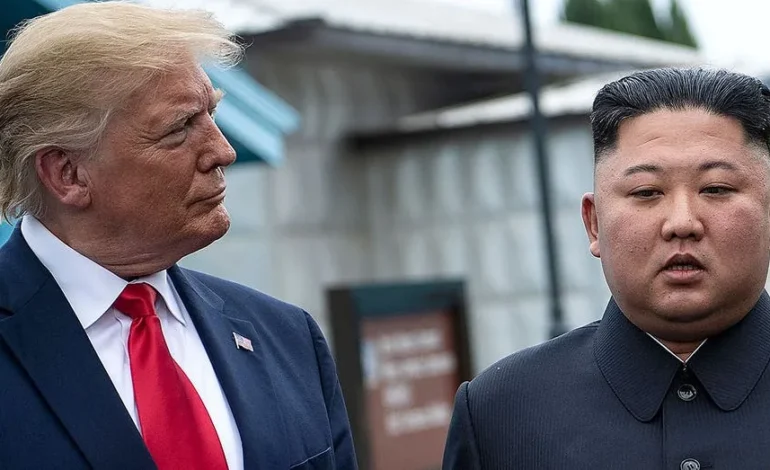

As former President Donald Trump signals a potential return to summit diplomacy with North Korean leader Kim Jong Un, he confronts a significantly altered landscape. North Korea now boasts a more substantial nuclear arsenal, has forged a potent alliance with Russia, and possesses considerably less motivation to strike a comprehensive denuclearization deal than during Trump’s previous term. This renewed diplomatic overture occurs while the U.S. remains engaged in a nuclear standoff with Iran, revisiting another complex foreign policy challenge from Trump’s presidency.
A Different Nuclear Equation
Unlike Iran, North Korea has already developed a mature nuclear weapons program complete with multiple delivery systems. This reality presents a stark contrast to the situation eight years ago, leaving Trump with limited military options and a narrower path toward a significant agreement. Victor Cha, the Korea Chair at the Center for Strategic and International Studies, suggests that Trump might view renewed engagement with North Korea as a strategic move to divert attention from the Iran situation and to reduce the number of adversaries facing the United States.
“I think he frankly wants to take the headlines off of Iran,” Cha commented, adding that Trump likely perceives North Korea as a distinct and more entrenched nuclear challenge. “There really isn’t a military solution for a country like North Korea that has 50, 60, 70 nuclear weapons and several delivery systems for those weapons.”
The Limits of Denuclearization
Given North Korea’s advanced nuclear capabilities, a sweeping agreement aimed at complete denuclearization appears increasingly out of reach. More realistic negotiations might instead focus on more constrained objectives. These could include:
- Establishing formal restrictions on nuclear and long-range missile tests.
- Creating channels for crisis communication between the U.S. and North Korea.
- Weakening Pyongyang’s burgeoning ties with Moscow.
- Pursuing a peace agreement that allows Kim Jong Un to retain his nuclear arsenal.
Kelsey Davenport, director for nonproliferation policy at the Arms Control Association, noted, “There is no grand bargain with North Korea that quickly eliminates the country’s nuclear arsenal. North Korea can drive a harder bargain now than it could have in 2018.”
Personal Diplomacy and Shifting Leverage
Trump has indicated an expectation of meeting Kim before the year’s end, emphasizing the personal relationship forged during their previous encounters as a valuable asset for restarting diplomacy. “I get along with him,” Trump stated. “And you know what? The fact that I get along with him, that’s a good thing, not a bad thing.”
While a White House official confirmed that the leaders “will meet at the appropriate time,” specific details regarding the timing, location, or preparatory stages remain undisclosed. The potential reward for Trump lies in securing a limited agreement that mitigates immediate nuclear risks, rather than achieving the complete dismantlement of North Korea’s arsenal.
Cha outlined several achievable goals short of full denuclearization, such as a formal ban on nuclear and intercontinental ballistic missile (ICBM) tests, a reduction in Pyongyang’s collaboration with Moscow, and the establishment of a crisis-management mechanism. Additionally, Cha suggested Trump might pursue a peace declaration or treaty, offering a symbolic resolution to a conflict that has technically remained unresolved since the 1953 armistice.
U.S. Bargaining Chips and Kim’s Calculations
Washington’s potential leverage includes phased sanctions relief, scaled-back military exercises with South Korea, a possible peace agreement, and the diplomatic capital derived from direct presidential engagement. For Kim Jong Un, an agreement that preserves his nuclear weapons could be framed as progress toward his regime’s long-standing objective of being recognized as a nuclear state.
Furthermore, Kim might see continued engagement with Trump as a means to mitigate the risk of military confrontation, especially given Trump’s past willingness to consider military force. Trump’s reduction of joint military exercises with South Korea, a step also taken during his first term, could be interpreted as an early negotiating gambit. North Korea, however, previously dismissed such a move as insufficient, proceeding with missile launches shortly thereafter.
Anthony Ruggiero, who served on the National Security Council during Trump’s first term, observed that the reduction in exercises aligns with a pattern established during earlier U.S.-North Korea diplomacy. “I’m kind of surprised that people are surprised. President Trump took the same action in his first term, and the only thing that’s really surprising is not that he did it; it’s that he waited this long to do it,” Ruggiero remarked.
A New Geopolitical Reality
The 2018 Singapore summit saw Kim pledge to work toward the denuclearization of the Korean Peninsula, though the agreement lacked specific timelines or verification measures. Pyongyang now largely rejects denuclearization as a basis for current negotiations. Cha highlighted that eight years ago, Kim faced greater pressure from UN sanctions and a deteriorating food situation, giving Trump more leverage. “It’s a very different situation now,” Cha stated.
This shift in leverage is partly attributable to North Korea’s deepening ties with Russia. Pyongyang’s provision of weapons and troop support for Russia’s war in Ukraine has fostered a closer relationship with a powerful partner capable of offering economic and military aid while also shielding North Korea from further international accountability. China also remains a vital economic partner for Pyongyang.
Despite these alliances, sanctions relief could still serve as a significant incentive. Ruggiero pointed out that the effectiveness of sanctions diminishes if the U.S. fails to close the avenues North Korea uses to circumvent them. “The North Koreans always complain that the sanctions don’t hurt them, but then that’s the first thing they always ask for,” he noted.
Potential for Humanitarian Progress and Risk Reduction
The recovery of American war dead from the Korean War era presents another potential avenue for concrete humanitarian progress. The Singapore agreement included a commitment to recover the remains of U.S. service members, and in 2018, North Korea returned 55 boxes believed to contain such remains. Future agreements could aim to revive joint U.S.-North Korean recovery operations, which last occurred in 2005.
However, a comprehensive disarmament deal remains improbable. Davenport advises that Trump should instead prioritize measures that reduce nuclear risks and slow the program’s expansion. These could include a moratorium on missile testing, enhanced crisis communication, and a potential freeze on nuclear development. “The ideal would be a return of International Atomic Energy Agency inspectors, but that’s not going to happen early in the process,” Davenport cautioned.
She suggested that satellite imagery could still play a role in monitoring reactor operations, plutonium reprocessing, and missile testing, although verifying a halt in uranium enrichment would be considerably more challenging. The establishment of a direct crisis-management channel holds intrinsic value, as Washington currently lacks a direct military communication line with Pyongyang. “If all of a sudden our radars pick up a ballistic missile flying through the air, we have no way of contacting North Korea to ask them, ‘Is this your intent? Did you send this?’” Cha explained.
Alliance Dynamics and Future Outlook
Cha also observed a degree of restraint in North Korea’s recent missile testing behavior. While Pyongyang conducted several ICBM tests during the Biden administration, including launches in 2022, 2023, and 2024, it has not tested an ICBM in flight since Trump’s return to office. North Korea has also refrained from nuclear testing since 2017.
Any potential agreement would inevitably test the U.S.-South Korea alliance. Seoul might welcome renewed dialogue after a period of stagnation, but it would likely be cautious about concessions impacting U.S. troop levels or joint exercises. South Korea was reportedly not forewarned about Trump’s reduction in military exercises, but could view renewed U.S.-North Korea negotiations positively if they restart diplomatic engagement.
Longer-term, South Korea would seek a role in any negotiations and assurances that its alliance interests are not compromised. “Where the rubber really hits the road on this is the whole question of U.S. troops in Korea because North Korea would like them out, South Korea would like them to stay, and it’s not entirely clear what President Trump wants,” Cha concluded.