




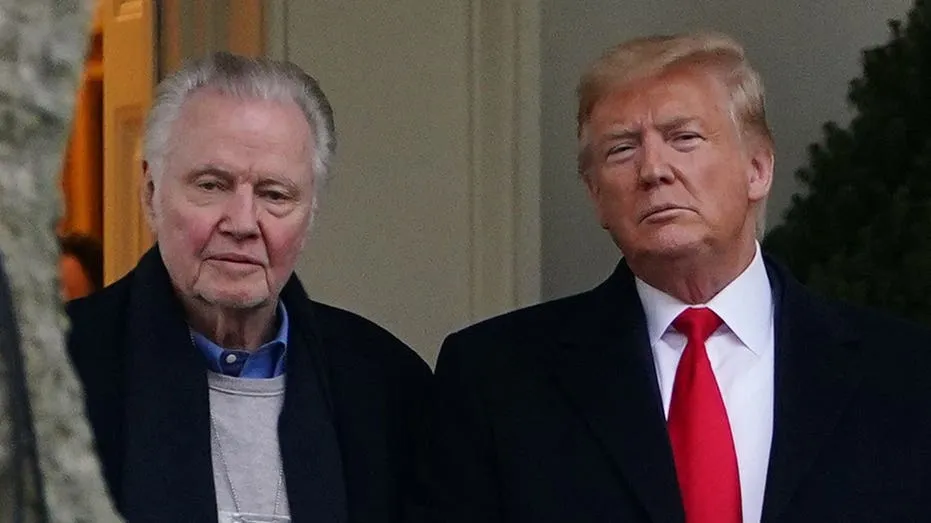
President Donald Trump has voiced strong criticism of Hollywood’s current state, labeling it a “total disaster” and advocating for a federal tax incentive to revitalize the American film and television industry. The remarks followed a significant meeting with actor Jon Voight, whom Trump appointed as a Special Ambassador to Hollywood.
Hollywood’s Declining Fortunes, According to Trump
During a discussion on his social media platform, Truth Social, Trump described his meeting with Voight, a “movie legend,” as “great and very interesting.” Voight, appointed in 2025 as part of a special envoy that also includes Mel Gibson and Sylvester Stallone, reportedly expressed deep concern over the industry’s trajectory. Trump shared that Voight “loves our Country, and feels strongly about the Motion Picture and Television Industry” but “hates what’s happened to it.”
According to Trump, the industry is “dissipated in its entirety” and has shifted production overseas to Canada and other countries, leaving very little work being done within the United States. “Hollywood is a Complete and Total Disaster!” Trump declared, noting that despite its name, the industry is experiencing a severe lack of activity. He attributed this decline to a lack of incentives, which he believes is causing significant harm to California.
A Proposal for Revival: Federal Tax Incentives
Voight, alongside other industry leaders, has proposed the implementation of a federal tax incentive aimed at restoring the prominence of American movie and television production. Trump indicated that the financial investment in such incentives would yield substantial returns, potentially tenfold, through increased revenue pouring into the Treasury.
The President stated that efforts are underway to convene leaders from both major political parties to advance this initiative. He emphasized the need for a bipartisan approach, particularly given the considerable economic losses experienced in California and other predominantly Democratic-leaning states. “I am going to suggest that Republicans and Democrats get together, and immediately craft Legislation to save the Movie, Television, and Entertainment Business in America,” Trump asserted. He called for Congress to promptly approve a Federal Production Incentive to stimulate job creation within the American entertainment sector.
Trump expressed optimism that the legislation could be enacted quickly, accurately, and efficiently, ultimately benefiting the entire nation. He stressed the importance of producing content for the “Silver Screen” within the United States, which was once the global epicenter of filmmaking. “Let’s get this done!” he urged.
Industry Support for the Initiative
Charles Rivkin, Chairman and CEO of the Motion Picture Association, welcomed Trump’s proposal. He stated that for over a century, American studios, casts, and crews have been at the forefront of producing globally popular films and series. Rivkin believes a federal incentive would represent a “landmark step” toward increasing production across all 50 states, thereby bolstering the national economy and enhancing America’s competitiveness in content creation.
“We applaud President Trump’s support for this vital action, and we look forward to continuing to work with the White House and bipartisan leaders in Congress to enact a meaningful and effective national incentive into law,” Rivkin added.
The Special Ambassadors Program
The Special Ambassadors program was initially announced by Trump shortly before his second term’s Inauguration Day, designed to foster business growth in Hollywood. At the time, he named Jon Voight, Mel Gibson, and Sylvester Stallone as Special Ambassadors to “a great but very troubled place, Hollywood, California.” Their role was to serve as special envoys, providing recommendations to help bring back the significant business that had migrated to foreign countries over the preceding four years.
Trump envisioned this initiative as a means to make Hollywood “BACK—BIGGER, BETTER, AND STRONGER THAN EVER BEFORE!” He described the three appointees as his “eyes and ears,” promising to implement their suggestions to usher in a “Golden Age of Hollywood” akin to the nation’s own golden age.
A Comprehensive Plan for Industry Reform
In May 2025, Voight, collaborating with special advisor Steven Paul, presented a detailed plan to the President aimed at revitalizing the film and television industry. This plan reportedly emerged from meetings with numerous film and television organizations, including guilds, unions, studios, and streamers, to identify necessary changes for boosting domestic production.
The proposal, discussed during an in-person meeting with Trump at his Mar-a-Lago residence and involving SP Media Group/Atlas Comics President Scott Karol, encompassed several key areas. These included federal tax incentives, modifications to tax codes, the establishment of international co-production treaties, and subsidies for infrastructure supporting theaters, production companies, and post-production services. The plan also emphasized job training initiatives and the potential application of tariffs in specific circumstances. The overarching goal, as stated, was to “level the playing field so that producing right here in America is not only a competitive option, but the first choice.”
At the time, the White House and its policy advisors were reviewing this comprehensive proposal. A White House spokesperson, Kush Desai, had previously indicated that while Trump regularly consulted with his Hollywood Ambassadors like Voight to restore America’s cultural influence, the concept of using tariffs to bolster Hollywood was an idea formulated by Trump himself.


