




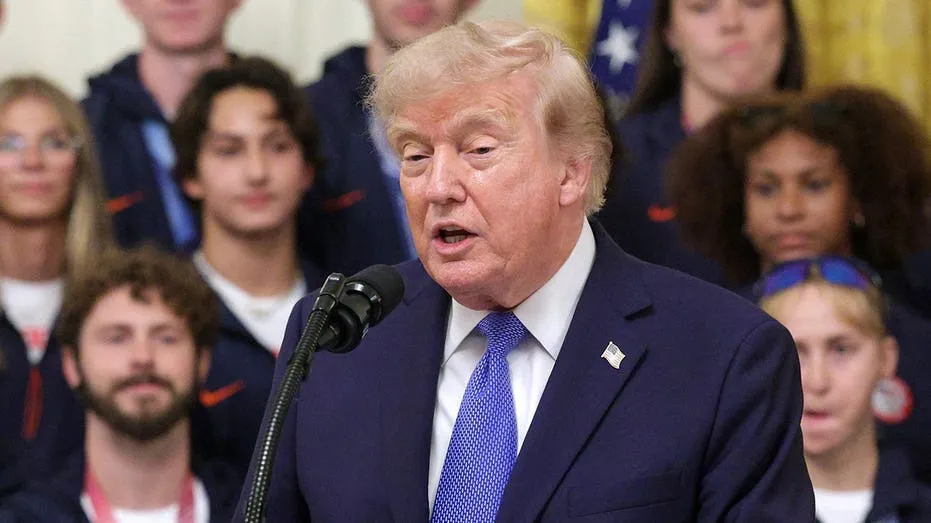
President Donald Trump has renewed his call for Congress to pass the Protect College Sports Act, emphasizing its urgency as lawmakers approach their upcoming recess. The President made his plea during a White House event honoring over 120 athletes, coaches, and staff from Team USA who competed in the Milano Cortina Winter Olympic and Paralympic Games.
Championing Collegiate Athletics
During the celebratory gathering, Trump highlighted the critical role of the collegiate athletic system in fostering American dominance in the Olympics, noting that 88% of Team USA’s representatives in the recent Winter Games hailed from college sports. He seized the moment to press the House and Senate to finalize and send the Protect College Sports Act to his desk for immediate signing.
“I’m urging the House and the Senate to come together, bipartisan if possible and it looks like they have done, to send the bill to my desk and I will sign it. I think we have no choice,” Trump stated. He cautioned that failure to act would be “foolish” and leave the future of college sports in an uncertain, “Never-Never Land.” He vowed, “We’re not going to let that happen to these great people and others.”
The President asserted that his administration is committed to safeguarding the nation’s treasured sporting traditions. “Already we’ve done a lot to save women’s sports, and we’re also saving college sports. We’re in the process of working very hard,” he added, suggesting progress in protecting both women’s athletics and the broader landscape of college sports.
Understanding the Protect College Sports Act
The Protect College Sports Act, a piece of bipartisan legislation actively supported by NCAA officials, aims to bolster the collegiate governing body’s antitrust legal standing. It also seeks to establish a unified national framework for key aspects of college athletics, including Name, Image, and Likeness (NIL) compensation rules, the operation of the transfer portal, and other critical areas.
However, the bill has encountered significant hurdles in the Senate. A notable challenge arose when three Republican senators introduced an amendment designed to prevent the legislation from superseding state laws that prohibit transgender women from competing in women’s sports. Senators Josh Hawley (Missouri), Jim Banks (Indiana), and Tommy Tuberville (Alabama) are championing this amendment, aiming to preserve state-level regulations they believe are essential for maintaining fairness in women’s sports.
Debate Over State Laws and Eligibility
These senators argue that the current draft of the Protect College Sports Act could potentially override existing state laws concerning college athlete eligibility. Their amendment seeks to ensure that such state laws, including those in their respective states that bar biological males from women’s sports, remain unaffected by federal legislation. Senator Hawley explicitly voiced his concern on social media platform X, stating, “I’ve reviewed the current draft of the Senate NIL bill and I am very concerned it PREEMPTS Missouri’s law banning men in women’s sports. This is what [Riley Gaines] has been saying. Big, big problem.”
While the full implications of this amendment on Republican support remain to be seen, President Trump is eager for the core legislation to advance. He expressed hope that the bill, providing a much-needed framework for college sports, would reach his desk without further delay.
Administration Policy Supports Legislative Action
Earlier on the same day, the Trump administration released a statement endorsing the passage of the act, reinforcing the President’s desire for a federal solution to the challenges facing college sports. The official statement of administration policy articulated that “The future of college sports, especially the future of Olympic and non-revenue sports, is threatened by significant legal and financial uncertainty.”
The statement continued, emphasizing the necessity of federal legislative action to “fix the statutory ambiguities, ensure liability protection and uniform standards, and stop the endless litigation that is fueling this crisis.” Such action, the administration believes, would provide the stability, fairness, and balance required to protect student-athletes and preserve collegiate athletic opportunities for the long term.
The Looming Congressional Recess
With the Senate scheduled to begin a five-week recess at the end of the week, the window for passing the Protect College Sports Act is rapidly closing. Lawmakers face a substantial agenda, and it remains uncertain whether this bill will be prioritized before they adjourn. President Trump’s remarks on Thursday evening served as a final push, urging swift action in the House and subsequent movement to his desk.
The push for the Protect College Sports Act underscores a broader debate about the governance, fairness, and future of collegiate athletics in the United States. As Congress weighs its legislative priorities, the fate of this bill hangs in the balance, with significant implications for athletes, universities, and the very structure of college sports.


