




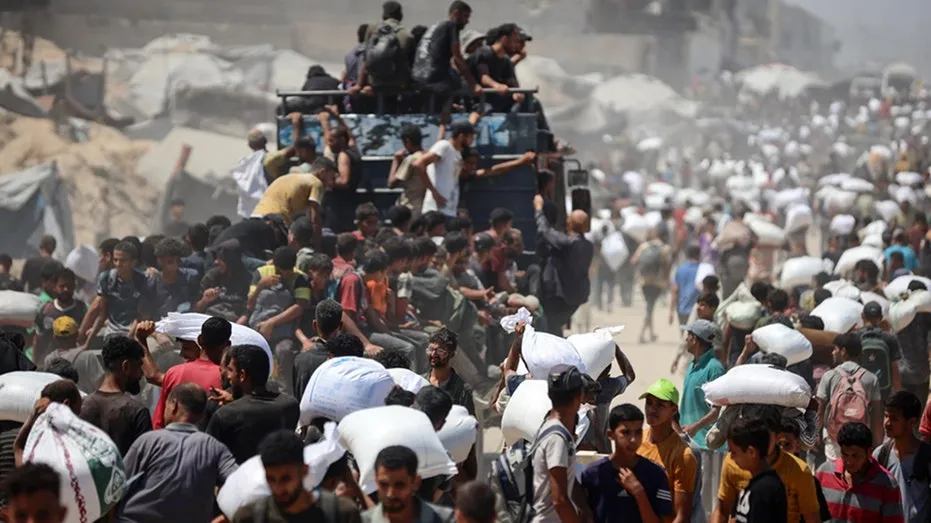
A recent report from UNICEF on malnutrition in Gaza has been described by the U.S. State Department as evidence that “completely shatters” accusations that Israel deliberately starved civilians in the Hamas-controlled territory. This development comes as previous United Nations assessments, widely reported by global media, had projected widespread starvation in Gaza extending through June.
The international scrutiny intensified following Hamas’s attack on southern Israel on October 7, 2023, which resulted in approximately 1,200 deaths and the abduction of 251 Israeli and foreign nationals. In response, Israel launched a military operation in Gaza, leading to widespread accusations of genocide and intentional starvation tactics against the Palestinian population.
The UNICEF-led National Nutrition Cluster report, released last month, surveyed 1,335 children under the age of five across 83% of the Gaza Strip to gauge malnutrition risks. The assessment utilized weight-for-height Z-score (WHZ) and mid-upper-arm circumference (MUAC) measurements. According to WHZ figures, malnutrition rates varied from 0.2% in Khan Younis and Rafah to 0.8% in Gaza City. MUAC measurements indicated malnutrition rates between 1.5% in Gaza City and 1.9% in Deir Al-Balah. It’s noted that approximately 17% of the population could not be included in the survey due to security and operational challenges.
State Department Rebuts Starvation Allegations
A State Department spokesperson commented on the findings, stating that “UNICEF’s latest findings demonstrate another example that completely shatters the countless false allegations against Israel of deliberate starvation of civilians in Gaza.” The spokesperson further asserted that “U.N. entities, media outlets and NGOs that should retract and correct their politicized and baseless attacks on Israel – which has provided an unprecedented over 2 million tons of food into Gaza since the ceasefire.”
The malnutrition rates documented by UNICEF appear comparable to, or even lower than, those observed in some neighboring countries. Data shared by the Israeli Coordinator of Government Activities in the Territories (COGAT) via X indicated that acute malnutrition figures in the region range from 1.3% in Gaza, Lebanon, and Turkey to 2.3% in Jordan, 3.3% in Egypt, 12.2% in Syria, and 17.7% in Sudan.
Contrasting Famine Projections
UNICEF’s report has drawn attention, particularly in light of a statement from the Integrated Food Security Phase Classification (IPC) that had “confirmed” famine in Gaza in August 2025. The IPC’s earlier warning projected that “through June 2026, at least 132,000 children under 5 are expected to suffer from acute malnutrition,’ including 41,000 severe cases where children would be ‘at heightened risk of death.'”
The IPC is anticipated to release a comprehensive report on Gaza’s conditions soon. Prior to this, their assessment suggested the Gaza Strip would be in Phase 2, the “alert” phase for malnutrition, between July and December 2026. They further projected that “74,200 children aged 6–59 months will likely require treatment for acute malnutrition through April 2027, with more than 11,400 severe cases expected.”
Notably, UNICEF’s July report indicated that “very few confirmed nutrition-related deaths have been reported during treatment” in Gaza. The IPC did not provide responses to inquiries regarding UNICEF’s findings or whether they stood by their previous famine declarations for Gaza.
U.S. Efforts and Expert Analysis
The State Department spokesperson also highlighted the United States’ role in facilitating humanitarian aid to Gaza, in collaboration with Israel. These efforts include measures to prevent Hamas from diverting or seizing aid. “The President has a bold and ambitious plan to rebuild Gaza, which is well underway through the efforts of the Board of Peace to facilitate disarming Hamas and ensure it is no longer a threat to Israel,” the spokesperson added.
Andrew Fox, a senior fellow at the Henry Jackson Society specializing in the Gaza conflict, characterized the new data as evidence that “the allegations of famine in Gaza were pure hysteria.” He suggested that while isolated instances of hunger might have occurred, the primary issue was likely distribution. “Once again, international organizations removed Hamas and their share of the blame for Gaza’s suffering from the conversation, stoking the anti-Israel narrative,” Fox stated.
Professor Aron Troen, director of the Nutrition and Brain Health Laboratory at The Hebrew University of Jerusalem, described the UNICEF findings as “very, very good news.” He found it remarkable that a region previously claimed to be experiencing a “deliberate and imposed political famine” now shows current malnutrition measures that are “better than… other places in the Arab world.”
Troen emphasized the importance of acknowledging positive developments alongside negative ones when assessing humanitarian needs. He criticized “narratives” surrounding the report that he believes serve political agendas, suggesting that a pragmatic transfer of governance requires moving away from accusations of genocide and famine for political gain.
UNICEF Clarifies Report Scope
Kurtis Cooper, Chief of Global Media at UNICEF, clarified that the recent nutrition survey reflects conditions in mid-2026, which is more than nine months after the IPC’s August 2025 famine confirmation and following a ceasefire and significant increase in humanitarian assistance. “It does not tell us what conditions were in August 2025, and it was never designed to,” Cooper explained.
Cooper elaborated on the improvements, noting that during the period covered by the August 2025 IPC analysis, malnutrition detection and treatment programs were operational, but widespread supplementary feeding had largely stopped due to access issues and supply disruptions. Program data indicated a peak in admissions for acute malnutrition treatment at nearly 17,000 children in August 2025, which then decreased to approximately 3,100 by May 2026.
Cooper did not directly address questions about how Gaza’s WHZ rates compared to those in other countries facing severe humanitarian crises. However, UNICEF reported in May that Sudan saw almost 100,000 children admitted for severe acute malnutrition treatment between January and March, with an estimated 825,000 children under five expected to experience severe acute malnutrition in Sudan in 2026.
Andrew Fox urged “leading organizations” to issue a “public and full retraction of their error-strewn papers,” arguing that such inaccuracies have fueled a rise in global antisemitism. Data from the J7 Large Communities’ Task Force Against Antisemitism indicated that 2025 was the deadliest year for antisemitic attacks globally since 1994.


