




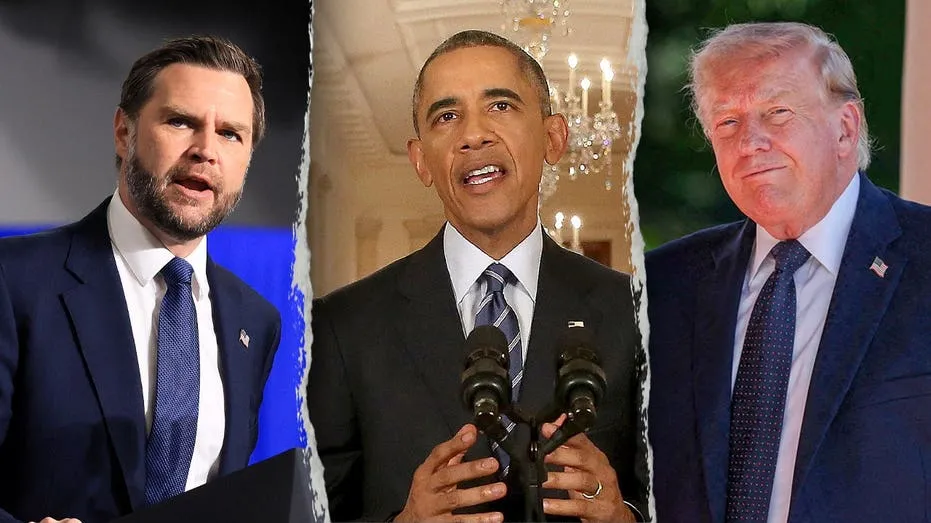
Vance Rejects Parallels Between Trump-Iran Agreement and Obama’s JCPOA
Vice President JD Vance is actively refuting comparisons drawn between the recently unveiled Trump-Vance agreement with Iran and the Obama administration’s landmark nuclear deal. The memorandum of understanding, details of which were released this week, aims to reopen the Strait of Hormuz and includes provisions for Iran to receive economic benefits contingent on its compliance with nuclear restrictions. Critics have highlighted this structure, asserting that it closely mirrors the approach taken by the Obama administration to promote the 2015 Joint Comprehensive Plan of Action (JCPOA), a deal long opposed by both Trump and Vance.
Vance, however, contends that such comparisons stem from a misunderstanding of the current pact’s mechanics. He suggests that the traditional “carrot-and-stick” approach, often associated with the Obama-era deal, has been inverted. “You’ve got Iranian propagandists out there saying, well, ‘we get all these things’, and they leave out the fact that they only get those things if they fundamentally transform themselves as a country,” Vance stated. He added that the agreement could potentially pave the way for broader economic cooperation for Tehran across the Middle East, provided Iran adheres to its commitments. “So the United States wins either way. As the president said, either they get nothing, we destroy their nuclear program and the Strait of Hormuz [is] open, or they fundamentally transformed themselves. And that’s a big one too. It’s really up to them,” he elaborated during a recent broadcast.
Critics Draw Parallels, Administration Argues Reversal of Strategy
Commentators have noted that the emerging deal appears to be the “exact opposite” of the framework established by President Obama and former Secretary of State John Kerry a decade ago. The argument is that under the new understanding, Iran’s funding of proxy groups would preclude it from receiving economic benefits. Furthermore, it is asserted that Iran’s missile capabilities have been significantly degraded, with a substantial portion of its industrial base and missile arsenal reportedly destroyed. This dismantling, proponents of the deal argue, leaves Iran disarmed, unable to re-arm effectively, and lacking the air and naval power to project significant threat.
Analysis suggests that Iran’s ability to enrich uranium is also severely hampered, with the U.S. being the sole entity capable of recovering residual uranium material. This assessment stands in contrast to the Obama administration’s defense of the JCPOA in 2015. At that time, President Obama emphasized that the U.S. “give[s] nothing up by testing whether or not this problem can be solved peacefully.” He also stated that if Iran were to violate the deal, “the same options that are available to me today will be available to any U.S. president in the future.” He further posited that a future president would be in a “far stronger position” due to enhanced transparency and monitoring measures.
Obama’s Warnings and Vance’s Counterarguments
In August 2015, President Obama also cautioned against efforts to undermine the JCPOA, anticipating attempts to discredit the agreement. He highlighted Iran’s incentives to uphold its commitments, pointing out that significant steps, such as dismantling centrifuges and eliminating stockpiles, would be required before sanctions relief. Obama noted that if Iran violated the agreement, sanctions could be reimposed, while compliance would foster economic reintegration and a growing incentive to maintain the deal.
However, some critics remain unconvinced. Senator Mark Kelly, a vocal opponent of the current administration’s approach, suggested the deal aligns more with what candidate Trump would have criticized. He expressed concern that the agreement provides “everything” Iran desires. Security expert Behnam Ben Taleblu also voiced reservations, describing any deal with the Islamic Republic as a “deal with the devil.” Taleblu recalled that Trump’s withdrawal from the JCPOA in 2018 was not due to a violation, but because the concessions gained by the U.S. were deemed insufficient in exchange for sanctions relief.
Skepticism and Path Forward
Taleblu suggested that a full public release of the current deal’s text would allow for a more accurate comparison with both the JCPOA and the earlier 2013 Joint Plan of Action (JPA), which he believes is a more relevant precedent. He noted that the JPA, a less comprehensive agreement that preceded the JCPOA, also involved a 60-day compliance window, similar to reports about the current pact. “Based on leaks of the [pending deal] in Bloomberg and CNN and Al-Arabiya, it’s not looking good,” he commented.
Beyond the specifics of the deal, there is also public tolerance for potential economic repercussions, such as fluctuations in gas prices or stock market performance, to be considered. Taleblu emphasized the need for more effective “political communications” to garner public support, given the long-standing adversarial relationship between the U.S. and Iran since 1979. He also cautioned that while conflict with Iran could strain the public, the economic fallout from a confrontation with a more complex adversary like China would be far more significant.
An official statement indicated that the memorandum of understanding includes immediate waivers for Iranian oil exports and a framework for substantial economic development. However, it was clarified that oil waivers are the only significant benefit Tehran would receive prior to a final agreement, following a 60-day evaluation period. During a briefing, officials conveyed skepticism regarding Iran’s intentions, stating that negotiations would cease if Iran was perceived to be disingenuous. The Vice President’s office was contacted for further comment.


