




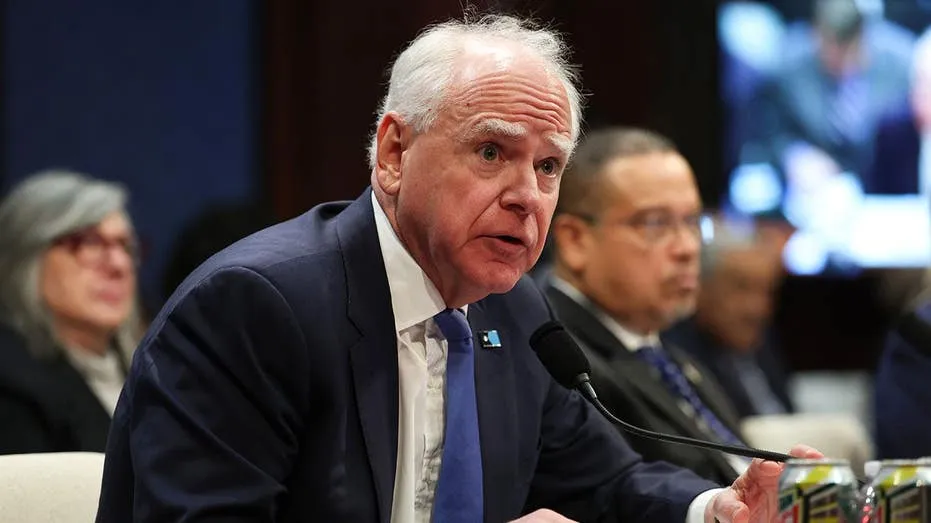
Minnesota Governor Tim Walz ignited a firestorm on social media Tuesday after criticizing a Supreme Court decision concerning transgender athletes in women’s sports. Walz characterized the ruling, which allows states to restrict transgender participation, as “cruel.” His statement immediately drew sharp rebukes from conservative critics, many of whom are Minnesotans themselves, who argued that the governor’s position was out of touch and harmful to female athletes.
Governor Walz Denounces SCOTUS Ruling
The Supreme Court’s decision, involving cases from West Virginia and Idaho, upheld state laws that mandate student-athletes compete based on their biological sex assigned at birth, rather than their gender identity. In response, Governor Walz took to the platform X (formerly Twitter) to express his disapproval. “As the Supreme Court says states can be cruel to trans kids, my message is clear: Here in Minnesota, we stand with and value our trans neighbors and youth,” Walz posted. The ruling, which passed with a 6-3 vote, effectively empowers over half of the U.S. states to enforce bans on transgender athletes in women’s sports without immediate legal threat.
Conservative Critics Fire Back
The governor’s remarks were met with swift and pointed criticism online. State Senator Julia Coleman, a Republican from Minnesota, voiced her strong opposition, questioning the governor’s definition of cruelty. “What’s cruel is making a teenage girl, already uncomfortable in her own skin, change in a locker room next to a naked boy,” Coleman posted. She further elaborated, “What’s cruel is letting our girls get the s— kicked out of them by biological males on the field and lose out on scholarships and more chances to compete. What’s cruel is putting your base above female safety and opportunities.”
Other prominent voices joined the fray. John Nagel, a retired Minnesota State Patrol Lieutenant and Republican congressional candidate, accused Walz of disregarding American laws and failing to support women’s rights. “You don’t support women’s rights. You don’t stand for anything. You are the face of everything that is wrong with the Democratic party,” Nagel wrote on X.
Renee Carlson, an attorney with True North Legal, posed a direct question to the governor: “Which Minnesota girl deserves to lose her spot on a team to a male athlete?”
A Republican National Committee account also weighed in, stating, “Tim Walz calls it ‘cruel’ that the Supreme Court ruled to protect young girls and keep men out of their sports. What’s actually ‘cruel’ is advocating for the gender mutilation of children and letting men in their locker rooms you sicko.”
State Senator Michael Holmstrom echoed these sentiments, arguing that the true cruelty lies in denying biological reality. “True cruelty to these children is perpetuating the LIE that they can be a different gender,” Holmstrom posted. “The consequence of which is the destruction of lives — and the victimization of girls across the state. The DFL has lost reality.”
Dustin Grage, a columnist for Townhall, offered a particularly harsh assessment, calling Walz “Worst Governor in America” and expressing hope for his imminent retirement.
Walz Clarifies Minnesota’s Position
Later on Tuesday, Governor Walz addressed reporters to clarify Minnesota’s stance following the Supreme Court’s decision. He explained that the ruling would not alter his state’s approach to transgender athletes in sports. “The Supreme Court has allowed states to be as cruel as they want to be to transgender people,” Walz stated. “They’ve also allowed states like Minnesota to be as kind and welcoming as they can, so I kind of view this as a mixed bag.”
Walz emphasized his administration’s commitment to inclusivity. “We’re going to view it as a positive considering what could have been done. In Minnesota, we can continue to treat our transgender athletes and youth with dignity and humanity and respect. We’ll continue to do that, nothing will change there,” he said. He also criticized the focus on restricting youth sports participation, noting, “Anything that gets kids involved, I want them to be involved. This idea of folks who have never been to any youth event are hell-bent on making sure some kid doesn’t participate in bowling is ludicrous. I think Minnesotans find there’s a lot of other things to worry about than three little kids wanting to play sports somewhere.”
The Supreme Court’s Rulings
The Supreme Court’s decisions in West Virginia v. B.P.J. and Little v. Hecox affirmed the right of states to legislate sports participation based on biological sex. This ruling provides legal backing for policies that exclude transgender girls and women from competing in female sports categories. While over 20 states currently lack specific laws on this matter and some have protections for transgender athletes, the Supreme Court’s decision offers a precedent for states wishing to enact or maintain bans.
Broader Landscape of Transgender Sports Policies
The legal landscape surrounding transgender athletes remains complex and varied across the United States. Following the Supreme Court’s decision, more than half of the states are now explicitly empowered to enforce policies restricting transgender participation in sports aligned with their gender identity. However, a significant number of states, including California, New York, and Massachusetts, do not have such restrictive laws, and some actively protect the right of transgender athletes to compete in the category that aligns with their gender identity.


