




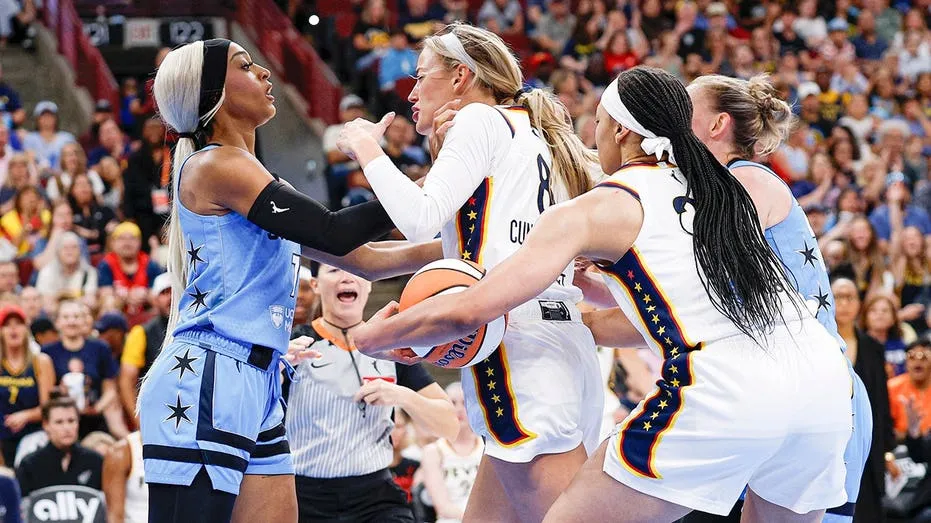
A contentious moment in a WNBA game between DiJonai Carrington and Sophie Cunningham escalated beyond a simple on-court incident, igniting a heated debate about race and privilege. The collision occurred when Carrington struck Cunningham in the face, leading to Carrington’s ejection and a subsequent social media post by Carrington that declared “White privilege.” This incident thrust the WNBA’s discourse back into discussions of race, adding another layer to ongoing conversations about the league.
From Football Fields to the Hardwood
The players involved, DiJonai Carrington and Sophie Cunningham, share an unusual commonality: both played football before their WNBA careers. However, their experiences with the sport and their backgrounds paint contrasting pictures.
DiJonai Carrington’s Path
Carrington, who grew up in San Diego, played flag football for two years and tackle football for another two during her elementary school years, inspired by her siblings. Her father, Darren Carrington, had an eight-year NFL career playing for five different teams, suggesting a background of significant financial means. DiJonai attended the private Horizon Christian Academy, where her mother served as her basketball coach. In 2015, she wrote an essay for ESPN.com about attending her brother’s Rose Bowl game.
Sophie Cunningham’s Journey
In contrast, Cunningham attended public school in Columbia, Missouri, though she also went to a private Catholic school in her younger years. She played football as a placekicker at Rock Bridge High School, a position that shielded her from tackling. Despite this, she made school history as the first girl to score varsity points. Cunningham often described her upbringing as “blue-collar,” emphasizing her roots on a 2,500-acre farm. She has spoken about the significant impact the 2008 financial crisis had on her family, whose father worked as a building contractor. Cunningham recounted how this period, despite its hardships, brought her family closer together.
College Careers: Different Routes, Shared Success
Both Cunningham and Carrington were highly recruited players, earning McDonald’s All-American honors and playing AAU basketball. However, their paths through college diverged significantly.
Cunningham’s Homegrown Talent
Cunningham’s recruitment was largely settled before she entered high school. She joined the Missouri Eclipse on the AAU circuit and, along with her sister Lindsey, received a full scholarship offer from the University of Missouri. This decision kept her close to home, continuing a family tradition as several relatives had also competed for Missouri. Cunningham quickly became a standout player, setting a school record with 42 points in her fourth college game. She earned SEC Freshman of the Year honors and helped Missouri reach the NCAA Tournament in all four of her seasons, finishing her career as the program’s all-time leading scorer.
Carrington’s Winding Road
Carrington’s college journey was more complex, marked by two ACL surgeries that limited her high school play. Despite these setbacks, she surpassed 2,000 career points and became a five-star recruit. She initially committed to Stanford University, where she was part of a Final Four team as a freshman. After becoming a full-time starter, she earned All-Pac-12 recognition. However, another knee injury during her senior season led her to transfer. After graduating from Stanford with two degrees, she entered the transfer portal and ultimately played for Baylor University, where she excelled as the team’s second-leading scorer and earned Big 12 Newcomer and Sixth Player of the Year awards. Baylor reached the Elite Eight during her tenure.
Entering the WNBA: Distinct Reputations Emerge
Both players were selected in the second round of the WNBA draft. Cunningham was chosen 13th overall by the Phoenix Mercury in 2019, while Carrington was selected 20th by the Connecticut Sun in 2021.
Cunningham: ‘The Enforcer’
During her six seasons with the Phoenix Mercury, Cunningham developed a reputation as an emotional player, earning the nickname “Spicy Sophie.” Known as a shooter and an agitator, she became known for her willingness to engage in confrontations. Before the 2025 season, she was traded to the Indiana Fever, joining Caitlin Clark. Her popularity surged after a hard foul on Jacy Sheldon, which many fans viewed as a protective act. Cunningham embraced her role as “The Enforcer,” cultivating a bold persona through fashion, social media, and a podcast. Her personal life has remained largely private, though she has spoken about wanting marriage and a family.
Carrington: Defensive Disruptor
Carrington spent four seasons with the Connecticut Sun, establishing herself as a formidable defender. She evolved from a reserve player into one of the league’s most disruptive perimeter defenders, earning WNBA Most Improved Player and All-Defensive First Team honors in 2024. Her public relationship with fellow Baylor standout NaLyssa Smith garnered significant attention, though Carrington resisted labels regarding her sexuality, stating, “I’m not gay, I just like Lyss.” Their relationship faced public drama, including accusations of infidelity made by Carrington in 2026.
Symbols of Divergent WNBA Narratives
By the time Carrington struck Cunningham on August 8th, both players had become more than just athletes; they represented different facets of the WNBA’s evolving landscape.
Carrington’s Activism
Carrington has been an outspoken advocate for racial justice, gender equality, and the treatment of Black women, drawing on her studies in African and African American studies. Her activism has made her a polarizing figure, admired by some and criticized by others. She faced racist messages and threats after an accidental foul on Caitlin Clark during the 2024 playoffs, even though Clark did not believe the contact was intentional.
Cunningham’s Conservative Stance
Cunningham emerged as a political figure from a different direction, voicing support for excluding transgender girls and women from female sports in 2026. This stance drew praise from conservative circles and led to protests at Fever games. Cunningham maintained her right to express her beliefs, transforming her from a popular player into one of the league’s most polarizing figures.
The Collision and Its Aftermath
The on-court incident between Cunningham, the white, heterosexual, Christian player seen as a conservative symbol, and Carrington, the Black activist and former public figure in a same-sex relationship, was viewed by many not just as a foul, but as a culmination of their public personas. Carrington’s subsequent “White privilege” post amplified this interpretation, turning the event into a potential defining moment for the WNBA. Carrington later clarified that her post was not about the officiating, stating she would not use the term “white privilege” without substantial evidence, though the exact meaning behind her statement remained somewhat ambiguous.
The incident highlighted the complex intersection of sports, identity, and social issues within the WNBA, demonstrating how player actions and backgrounds can ignite broader cultural conversations.


