
WNBA Faces Scrutiny Over Carrington’s ‘White Privilege’ Post
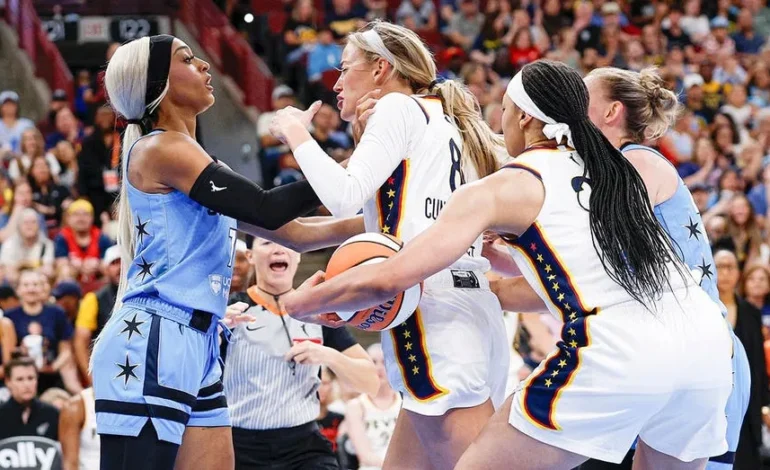

The WNBA is navigating a delicate disciplinary situation following an incident involving Chicago Sky guard DiJonai Carrington and Indiana Fever guard Sophie Cunningham. Carrington was ejected from Saturday’s game for a Flagrant 2 foul, and shortly thereafter, a post appeared on her social media account reading, “WHITE PRIVILEGE @indianafever.” This statement has ignited a debate about the league’s response to player conduct and accusations of racial bias.
Incident Details and Ejection
The controversy unfolded late in the first quarter of the game between the Chicago Sky and the Indiana Fever. Carrington was assessed a Flagrant 2 foul for striking Cunningham across the head as Cunningham attempted a layup. The play was reviewed by officials, leading to the automatic ejection of Carrington. Reports indicate that Cunningham required attention after the play, with visible signs of bleeding from her mouth.
The Indiana Fever ultimately won the game against the Sky with a score of 90-86. However, the focus quickly shifted from the game’s outcome to Carrington’s post-ejection statement on Threads, which appeared to directly link the foul and her ejection to racial privilege.
The ‘White Privilege’ Accusation and League Dilemma
Carrington’s post, tagging the Indiana Fever, has placed the WNBA in a challenging position. While the statement did not explicitly accuse referees of racism, its timing and wording strongly suggest such an interpretation. The league must now decide how to address the post, balancing the need for consistent disciplinary action with the potential repercussions of punishing a player for making such an accusation.
Commissioner Cathy Engelbert has previously stated that the WNBA applies its rules and disciplinary processes uniformly across all games and players. Failing to act decisively on Carrington’s post could undermine this assertion and create a perception of unequal standards. Conversely, imposing a severe penalty might alienate other players and draw criticism from segments of the sports media and fan base.
Multiple organizations, including the WNBA, the WNBA Players’ Association (WNBPA), and the Chicago Sky, were reportedly contacted for comment regarding Carrington’s post. Inquiries focused on whether the league interpreted the message as an allegation of racial bias in officiating, whether Carrington had been spoken to about the post, and if a review was underway. The Sky were asked about the intended meaning of Carrington’s statement and whether the organization supported her characterization. The WNBPA was questioned about its stance on racial bias in officiating and whether it supported Carrington’s use of the term “white privilege.” As of the initial reporting, none of these entities had provided a response.
Context and Potential Interpretations
Complaints about officiating are a common occurrence in professional sports, with players and coaches frequently voicing dissatisfaction with calls made on the court. However, Carrington’s use of the term “white privilege” immediately following an officiating decision introduces a layer of complexity, suggesting that race, rather than simply judgment, may have influenced the call.
If Carrington intended to accuse referees of racial bias, clarity and supporting evidence would be crucial. Alternatively, if her message was not directed at officiating, a simple clarification could resolve the ambiguity. The situation is further complicated by Sophie Cunningham’s public stance on transgender athletes competing in women’s sports. Cunningham’s views have previously sparked significant debate and public reaction, including protests at Fever games and disagreements within the WNBA community.
This context raises the possibility that Carrington’s post might have been aimed at a broader issue than just the officiating incident itself. The WNBA has, in recent years, encouraged players to speak out on political and social matters. If the league is to maintain consistency, it must address accusations like Carrington’s with the same seriousness it has applied to other player-led discussions on social issues.
The WNBPA’s Position
The WNBPA also faces scrutiny in light of its recent statements condemning “hate, abuse, and demonization of any person or group of people, including transgender people.” If the union’s commitment to addressing harm applies universally, it may need to reconcile this stance with supporting a player who invoked “white privilege” in a public forum during a game.
The lack of immediate response from the WNBA, the WNBPA, and the Chicago Sky leaves Carrington’s two-word statement to speak for itself, creating uncertainty and fueling ongoing discussion about the incident and its implications for the league.
Looking Ahead: Discipline and Perception
The WNBA’s handling of this situation will likely be closely watched. The league’s decision will send a message about its commitment to fair play, its approach to player expression, and its willingness to address sensitive issues like race within the sport. The outcome could influence player-referee relations, league-wide discourse, and public perception of the WNBA’s disciplinary standards.
As the league considers its next steps, the focus remains on how it will balance accountability with the complexities of player speech in an era where social and political commentary has become increasingly intertwined with professional sports.