



Fauci’s 111 Fifth Amendment Pleas: A Legal Showdown Ahead?
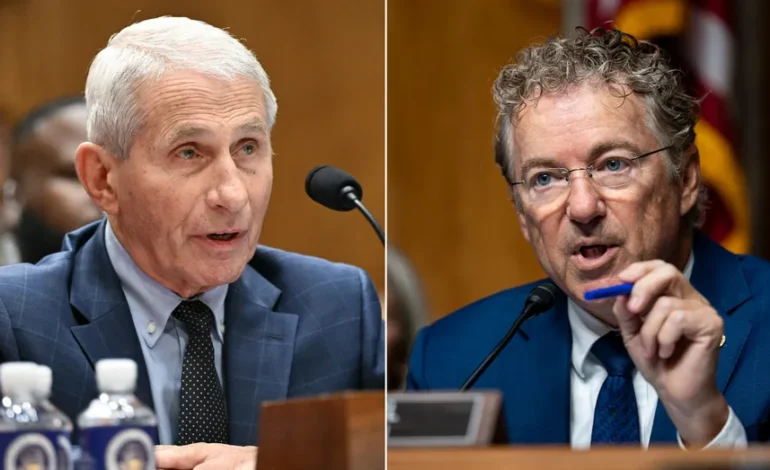

Dr. Anthony Fauci, the long-serving director of the National Institute of Allergy and Infectious Diseases, recently invoked his Fifth Amendment right against self-incrimination a remarkable 111 times during a Senate hearing. This extensive use of the constitutional protection, advised by his legal counsel, has prompted Senate Homeland Security and Governmental Affairs Committee Chairman Rand Paul, R-Ky., to explore potential repercussions, including contempt of Congress charges.
Fauci’s Stance and Paul’s Response
During the hearing, the only words Dr. Fauci uttered beyond his opening statement were repeated assertions of his Fifth Amendment privilege. Chairman Paul warned Fauci of consequences, stating, “There will be repercussions to your refusal to testify today.” He further elaborated that the committee would consider appropriate actions for failing to testify when directed, emphasizing that obstructing a congressional investigation is against the law.
Fauci, in his opening remarks, expressed his belief that the hearing’s purpose was to elicit a statement that could be used to justify calls for his imprisonment, a sentiment he attributed to what he described as Paul’s “unhinged obsession” with him. Following this declaration, he remained largely silent, declining to answer questions on various topics, including his personal diary and the origins of the pandemic.
Strategic Questioning and Legal Nuances
Sen. Josh Hawley, R-Mo., posed seemingly innocuous questions, such as the day of the week or the color of Fauci’s tie and the carpeting. These were not mere conversational pleasantries but a strategic legal maneuver. The intent behind such questions, according to legal interpretations, is to potentially invalidate the blanket invocation of the Fifth Amendment. If Fauci had answered these simple queries, it could have been argued that the Fifth Amendment shield no longer applied, potentially compelling him to answer subsequent, more substantive questions.
Republicans argued that Fauci should have been able to answer these trivial questions, as they were unrelated to any potential criminal proceedings. However, Fauci consistently invoked the Fifth Amendment, even for these basic inquiries, adhering strictly to his legal strategy.
Historical Precedents and Legal Interpretations
Dr. Fauci’s extensive use of the Fifth Amendment is notable, though not a Senate record. In 1958, mob boss Vito Genovese invoked the Fifth Amendment 150 times before a Senate panel investigating organized crime. This historical parallel highlights the constitutional right’s application in various high-stakes hearings.
A point of contention among lawmakers is whether Fauci’s pardon from former President Joe Biden should preclude him from invoking the Fifth Amendment. Republicans argued that with immunity, he should testify. Democrats, however, countered that the objective was to place Fauci in legal jeopardy, making the Fifth Amendment a prudent course of action, as stated by Sen. Richard Blumenthal, D-Conn.
The legal basis for challenging the Fifth Amendment invocation, even with immunity, can be traced to the 1896 Supreme Court case Brown v. Walker. In this ruling, the Court held that a witness granted immunity must still testify, even if the testimony might be embarrassing or bring them into disrepute, as long as it doesn’t directly incriminate them. The principle suggests that immunity negates the risk of incrimination, thus requiring testimony.
Comparisons to Past Cases and Potential Prosecutorial Discretion
Fauci’s conduct has drawn comparisons to that of Lois Lerner, a former IRS official who invoked the Fifth Amendment in 2014 during a House Oversight Committee hearing concerning allegations of targeting conservative groups. After delivering an opening statement, Lerner invoked her Fifth Amendment rights. The House later voted to hold her in contempt of Congress, referring the matter to the Justice Department, which ultimately did not prosecute her under the Obama administration.
The decision of whether to prosecute a contempt of Congress citation often hinges on the political landscape, specifically which party is making the referral and which party controls the Justice Department. Historical examples include the Republican House referring former Attorney General Eric Holder for contempt, a referral that went nowhere as Holder led the DOJ. Similarly, a Democratic House referred Harriet Miers to the DOJ during the George W. Bush administration, without action. In contrast, the Biden Justice Department prosecuted Steve Bannon and Peter Navarro after contempt referrals from the Democratic House regarding the January 6th investigation.
The Path Forward: Contempt and Judicial Review
Chairman Paul intends to initiate a resolution holding Dr. Fauci in contempt of Congress. However, such a measure requires full Senate approval, including overcoming a potential filibuster, which necessitates 60 votes. This procedural hurdle makes contempt citations less common in the Senate compared to the House, where a simple majority suffices.
Paul has indicated a strategy to bypass some of these Senate procedures by sending the contempt resolution and supporting legal brief directly to the Department of Justice. This approach places the decision to prosecute squarely on the DOJ.
The question remains whether the DOJ, under a potential future Trump administration, would view Fauci’s actions differently than the Trump administration’s DOJ viewed his previous referrals, or how the Obama DOJ viewed Lois Lerner’s invocation of the Fifth Amendment. The Lerner case, where the DOJ declined prosecution after a Fifth Amendment assertion post-opening statement, could set a precedent. Alternatively, a new administration might pursue a more aggressive stance.
Conclusion: A Potential Landmark Legal Battle
Dr. Fauci’s decision to invoke the Fifth Amendment 111 times may lead to a significant legal confrontation. The outcome could hinge on prosecutorial discretion, the interpretation of the Brown v. Walker ruling, and the implications of his presidential pardon. Whether silence proves to be golden for Dr. Fauci or leads to a protracted court battle remains to be seen, with the judiciary potentially playing a pivotal role in defining the boundaries of constitutional protections in congressional investigations.