



Humanoid Robot Smashes Usain Bolt’s 100m Record

The image of a humanoid robot might conjure up visions of clunky movements and awkward demonstrations. However, recent advancements have dramatically reshaped that perception. A Chinese humanoid robot has now achieved a 100-meter sprint time faster than Usain Bolt’s legendary world record, signaling a remarkable acceleration in robotic capabilities.
Robots Outpace Human Speed Records
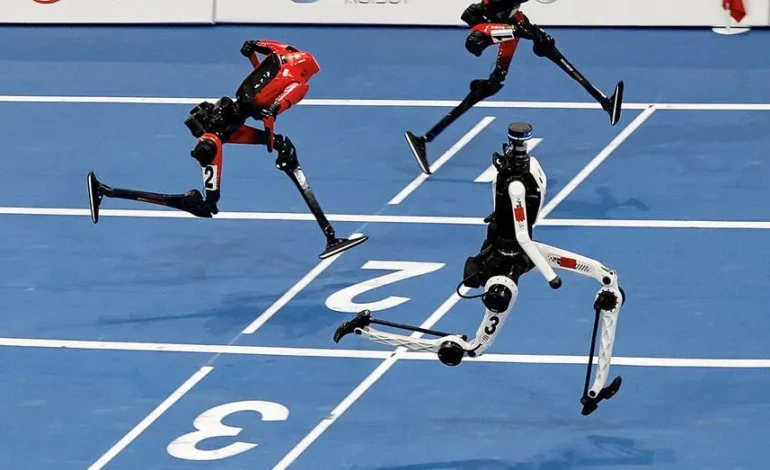
At the recent World Humanoid Robot Games held in Beijing, an X-Humanoid robot named TianGong Ultra clocked an astonishing 9.32 seconds for the 100-meter dash. This performance surpassed the 9.58-second record set by Jamaican sprinter Usain Bolt in 2009. While the robot’s achievement occurred in a specialized competition with its own set of rules, distinct from official track and field events governed by World Athletics, the speed at which this technology is evolving is undeniable.
The Games, which took place from August 22nd to August 26th at Beijing’s National Speed Skating Oval, saw significant participation, with organizers registering 666 teams and 2,056 robots. These machines competed across 51 events, including traditional track and field disciplines, as well as challenges designed to simulate real-world job tasks, weightlifting, and even tug-of-war. This diverse range of competitions highlights China’s ambition to develop versatile and physically capable humanoid machines.
Rapid Strides in Robotic Mobility
The speed of progress is particularly striking when compared to the previous year’s event. In the inaugural World Humanoid Robot Games in 2025, the winning robot completed the 100-meter sprint in a comparatively slow 21.50 seconds. The leap to under 10 seconds in just one year demonstrates an exponential improvement in robotic locomotion. This rapid development extends beyond mere speed; an X-Humanoid robot also achieved an impressive standing high jump of 2.88 meters (approximately 9 feet 5 inches), exceeding the men’s high jump world record set by Javier Sotomayor.
While these robotic feats are impressive, it’s crucial to maintain perspective. The conditions under which robots compete differ significantly from those of human athletes. A robot’s ability to maintain balance and coordinate its movements at such speeds requires sophisticated integration of motors, balance systems, sensors, and software, all working in concert to make continuous micro-adjustments. This complex interplay of technology is what truly underscores the advancement.
Beyond the Racetrack: Real-World Applications
The implications of these advancements extend far beyond athletic achievements. Enhanced mobility and agility in humanoid robots could revolutionize various industries and critical operations. Robots capable of navigating challenging terrains could be deployed in disaster zones, performing dangerous tasks that would otherwise put human lives at risk. Machines with superior balance and strength could handle physically demanding jobs, potentially transforming manufacturing, logistics, and construction.
The Prospect of Robot Soldiers
One of the more provocative discussions emerging from the Games centers on the potential military applications of humanoid robots. Yang Kun, a robotics engineer at AG BOT, a Shanghai-based company, expressed a belief that Chinese firms could develop robot soldiers within the next five to ten years. While this is a projection from an individual developer and not an official government stance, it signals a direction some in the field are exploring. Such predictions, even if speculative, highlight the rapid evolution of robotics towards complex, potentially high-stakes roles.
The battlefield presents a vastly different challenge than a controlled sprint. Navigating unstable ground, overcoming obstacles, and making split-second decisions in unpredictable environments are far more complex than running in a straight line. Military scenarios introduce further complications, including potential communication blackouts and sensor misinterpretations, pushing the boundaries of current AI and robotic control systems.
The U.S.-China Tech Race Intensifies
The rapid progress in humanoid robotics adds a significant physical dimension to the ongoing technology race between the United States and China. While advancements in artificial intelligence have been a major focus, the ability to integrate sophisticated AI into robust, mobile robotic bodies and manufacture them at scale could provide a substantial strategic advantage. This convergence of AI and advanced robotics allows software to interact directly with the physical world, opening up possibilities for industrial automation, exploration of hazardous environments, and operations in areas where human presence is too risky.
Recognizing the strategic implications, U.S. regulators have begun to treat advanced foreign robotics as a national security concern. The Federal Communications Commission (FCC) recently added certain foreign-produced advanced robotic devices, including qualifying humanoid robots, to its Covered List. This measure restricts the import and sale of these devices in the United States, underscoring Washington’s view of connected robots as more than just consumer gadgets.
The Future of Humanoid Robotics
The development of humanoid robots has long been hampered by the fundamental challenge of creating a stable, two-legged machine capable of efficient movement. While engineers continue to refine these systems, today’s robots exhibit a level of agility unseen just a few years ago. This progress allows developers to shift their focus towards enhancing artificial intelligence, enabling robots not only to perform physical tasks but also to understand their surroundings and make informed decisions.
The potential applications are vast. The balance systems enabling robots to sprint could assist in navigating post-earthquake rubble. Improved sensors could enhance safety in human-robot collaboration in industrial settings. Factories, designed primarily for human workers, are a natural early adoption ground for humanoids, potentially requiring minimal modifications to existing infrastructure. As reliability increases and costs decrease, the deployment of these machines is expected to expand into numerous other sectors.
The ethical considerations surrounding autonomous decision-making in robots, particularly in military contexts, raise critical questions about accountability and control. These conversations are becoming increasingly urgent as the technology advances rapidly, necessitating proactive dialogue before machines reach a level of autonomy that forces immediate, reactive policy decisions.
Key Takeaways
- The most compelling aspect of the recent World Humanoid Robot Games is not just the speed of the robots, but the rapid improvement in their overall capabilities, particularly in mobility and balance.
- A Chinese humanoid robot’s 100-meter sprint time under 9.4 seconds, while not an official world record, signifies a major leap in robotic engineering.
- The potential for military applications, with one engineer predicting robot soldiers within a decade, highlights the accelerating pace of development and its broader geopolitical implications.
- This technological race between the U.S. and China extends beyond AI to the physical embodiment of that intelligence in advanced robotics, potentially offering significant strategic advantages.
- While impressive, the ability to run fast on a controlled track is a different challenge than navigating complex, unpredictable real-world environments, indicating that significant hurdles remain in areas like decision-making and adaptability.