
Fetterman’s Political Evolution: From Progressive Populist to Internal Critic
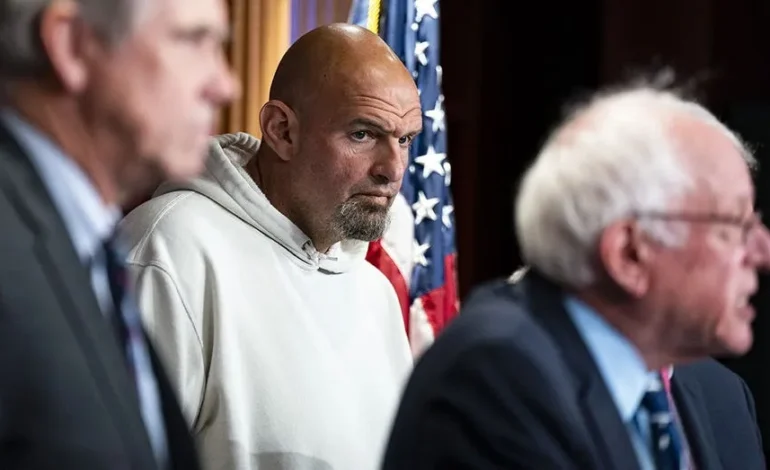

The recent political downfall of Graham Platner in Maine has served as a significant marker in the public evolution of Pennsylvania Senator John Fetterman. Once a prominent progressive populist backed by Senator Bernie Sanders, Fetterman has increasingly positioned himself as one of the Democratic Party’s more vocal internal critics. He was among the first prominent Democrats to publicly address the controversies surrounding Platner’s Senate campaign, even as many party leaders initially maintained their support.
A Stark Break from Past Alliances
Fetterman’s transformation has been underscored by his sharp critiques of former allies, most notably Senator Bernie Sanders. Following Platner’s withdrawal from the race amid mounting allegations, including a denied accusation of rape by a former girlfriend, Fetterman did not shy away from expressing his views. In an interview, he remarked, “The trash took itself out,” when asked about the chaos surrounding Platner’s campaign.
More pointedly, Fetterman called for Senator Sanders to apologize to the voters of Maine and to the campaign donors. “Absolutely, Bernie Sanders needs to apologize to the voters of Maine and to everyone that donated to that train wreck of a campaign,” Fetterman stated. While Sanders eventually urged Platner to end his candidacy after the allegations surfaced, Fetterman argued that the Vermont progressive owed voters a deeper apology for his initial role in elevating Platner. “More than anyone, he pushed ‘P. Hustle’ into the election. And now he keeps pushing these Communists and these kinds of awful, anti-American people,” Fetterman elaborated.
A Dramatic Political Shift
These comments represent a significant shift for Fetterman, who has openly acknowledged a surprising level of popularity with some Republicans, despite his voting record aligning with the Democratic Party approximately 90% of the time. He has also expressed support for Israel and, in a notable departure, for President Donald Trump’s past actions against Iran.
Chris Borick, a professor at Lehigh University, described Fetterman’s changing relationship with Sanders and the progressive wing of the Democratic Party as “dramatic.” Borick noted the unprecedented speed and scope of Fetterman’s shifts in positions on various issues within Pennsylvania politics, drawing comparisons to historical party switches but highlighting Fetterman’s rapid departure on significant matters as unique.
Navigating Pennsylvania Politics
Fetterman’s divergence from the party’s left flank extends beyond national figures like Sanders. Within Pennsylvania, his increasingly independent stance has also created distance from segments of the state’s Democratic establishment. He has, at times, broken with partisan norms.
State Senator Doug Mastriano, a Republican who served in the Pennsylvania Senate during Fetterman’s tenure as lieutenant governor, recalled Fetterman as being generally “gracious and respectful,” despite political differences. Mastriano shared an anecdote about Fetterman congratulating him on the Senate floor for accumulating a record number of ballot signatures for his gubernatorial campaign. Mastriano commented, “I can’t speak for Sen. Fetterman’s political evolution — that’s something only he can explain. But I do respect anyone who is willing to speak their mind, think independently, and put what they believe to be America’s interests first, even when doing so may not be popular within their own party.” Mastriano suggested Fetterman appears to be “put[ting] Pennsylvania ahead of politics.”
In a recent instance, Fetterman collaborated with Republican Senator David McCormick to secure a booth on the National Mall for the Great American State Fair, an effort that the office of current Governor Josh Shapiro had deemed unfeasible due to time and vendor constraints. This action occurred after Fetterman had previously served as lieutenant governor under Governor Tom Wolf.
Roots in Progressive Populism
Fetterman’s political journey began with a strong alignment with Sanders, riding a wave of progressive populism to the lieutenant governor’s office. During his 2018 campaign for lieutenant governor, Fetterman actively promoted Sanders’ endorsement as validation of his progressive credentials, portraying the senator as a champion for the “little guy.” At the time, Fetterman was the mayor of Braddock, a working-class Pittsburgh suburb, and his populist image was already gaining national attention.
Sanders himself campaigned for Fetterman, stating, “What John’s campaign is about… is that we are going to transform this country and create a government that works for all of us, not just wealthy campaign contributors.”
Questions About Candidate Quality
Sam Chen, a political analyst and strategist, highlighted the significance of Fetterman’s shift from Sanders ally to critic. Chen questioned whether the broader political climate within the Democratic Party contributed to this break. “Fetterman was really helped by Sanders — even in Fetterman’s first Senate run… and then against who we really thought was probably the frontrunner in Conor Lamb,” Chen noted. “Sanders really helped put Fetterman on the map and helped get him over the top,” he added, characterizing Fetterman’s recent condemnation of Sanders as his “biggest break” from the progressive wing.
However, Chen also raised questions about the underlying motivations for Fetterman’s stance on Platner, suggesting it might be less about policy differences and more about concerns over judgment and character. “I wonder if Fetterman would have had this position if Platner had all his policy views that he has now but there was no Totenkopf tattoo or allegations from women,” Chen mused.
Current Standing and Future Outlook
Despite his evolving political identity, Fetterman’s progressive “bona fides” on issues like LGBTQ rights, marijuana legalization, and abortion remain consistent. Yet, his break with the progressive coalition that propelled him into national politics is evident in his current standing. Some Pennsylvania Democratic groups have labeled him a “traitor,” and his potential for a 2028 reelection bid is reportedly uncertain, with no members of the state’s House delegation publicly confirming support.
Representative Summer Lee, who represents Fetterman’s hometown and shares ideological alignment with Sanders, commented that the senator might run “at his own peril” given his increasingly isolated position. The senator’s journey illustrates a complex navigation of party loyalties, personal convictions, and the ever-shifting landscape of American politics.
While Fetterman’s past as mayor and lieutenant governor did not heavily involve foreign policy, his current role in the Senate places these issues, and his evolving positions on them, under greater scrutiny. His break with the progressive movement, exemplified by the Platner controversy, signals a significant chapter in his political career, demonstrating a willingness to prioritize his own judgment and perceived national interests, even at the cost of alienating former allies.